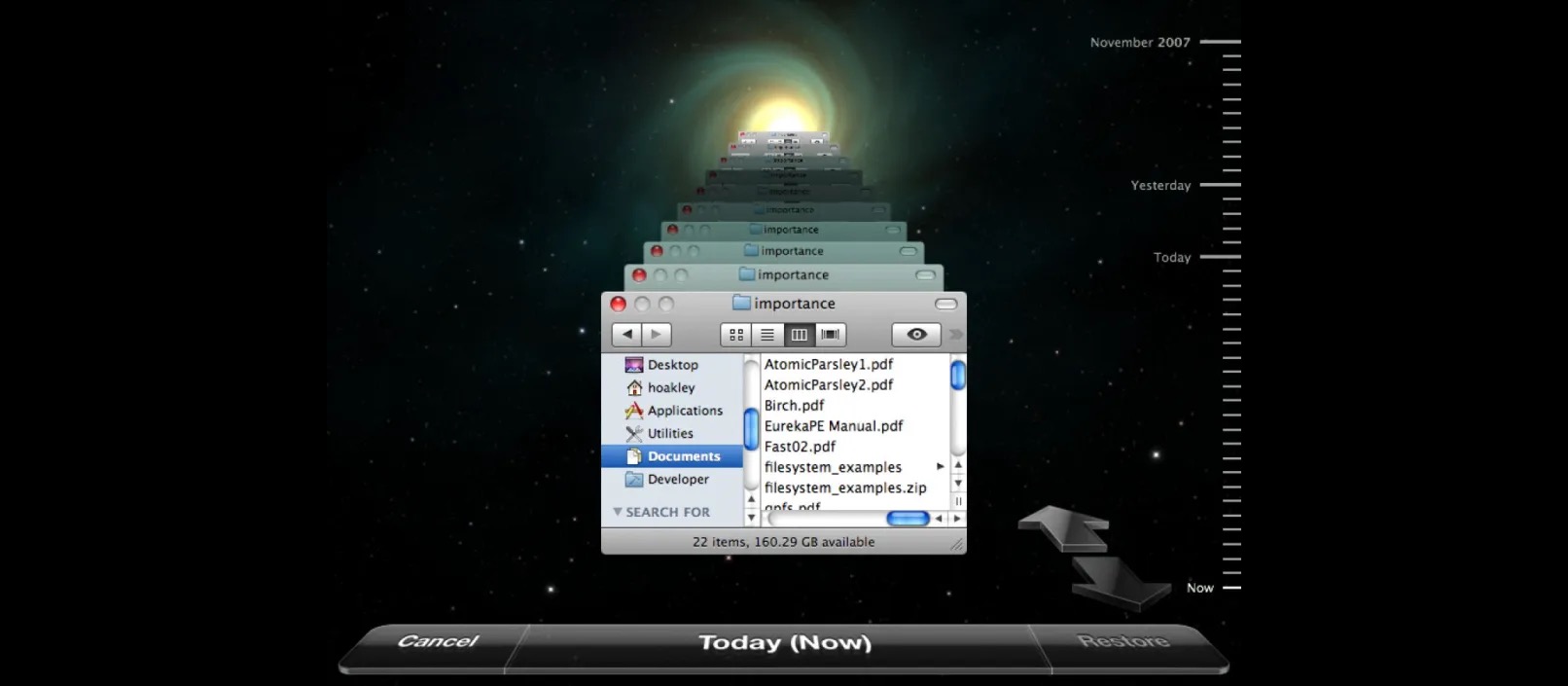
The inspiration for Margin
They say imitation is the greatest form of flattery.
The core idea behind Margin isn’t new. I borrowed it from a piece of software I first saw years ago, and I’ve never really let it go.
They say imitation is the greatest form of flattery. So consider this my thank-you note to Time Machine.
The interface that stuck with me
Time Machine did something I’d never seen before. Instead of listing your backups as dates/folders, it laid your Mac’s whole history out as a timeline and let you fly backward through it with every past version of your drive receding into the distance and the present one up front.
The backups themselves were ordinary. The way you moved through them was not.
I never searched. I remembered when.
When I lost a file, I didn’t hunt for it by name. I already knew roughly when I’d last had it: before that trip, around the deadline, the week everything broke, etc. So I’d just navigate to about the right moment, and I’d find it pretty quickly.
I was recovering things by memory, and the interface matched the way my memory already worked.
Memory is shaped like a timeline, not a search box
Sometimes we do remember by keyword: a name, a phrase, that one word that anchors the whole thing down, and we’ve been trained for years to drop it into a search box. Which is why it isn’t going anywhere, and it shouldn’t because it’s incredibly useful.
But mostly, we remember by when. “That was around the time we moved.” “I think it was just after the new year.” Ask someone to find a moment and watch them scrub backward in their mind’s eye until they land near it. Memory is shaped more like a timeline than a search box.
Time Machine felt effortless because it referenced this more primal way of recalling. Even if you know the word to search for, it’s easier to begin with a rough when instead, and it carries you the rest of the way.
You already do this with your photos, and it brings the joy of discovery to the experience
Think about scrolling your photo library. Apple Photos, Google Photos, whichever you use, they lay your life out as a timeline and let you drift back through it. I find the discovery aspect while scrubbing incredibly joyful: you scroll past a week you hadn’t thought about in years and the whole thing comes rushing back.
I didn’t search for that memory. I traveled near it and it found me. That is the same reward Time Machine gave me, and it’s the one I wanted writing to have.
A journal should work the same way
I’ve kept physical journals for a long time. It started because I needed a place to sort my thoughts out and turned into a healthy outlet and thus a healthy habit. But the joy came from flipping back through them and reminiscing. No digital journal I’ve tried ever brought me joy because they all focus on the utility of journaling but forget about the equally important reminiscing.
So Margin keeps the search box, but lays your writing out on a timeline too. When you know the word, type it. When you don’t, do what you already do in your head: remember roughly when, and scrub back through time. You’ll find what you’re looking for (eventually), but you may also rediscover and remember more.
Imitation, but pointed somewhere new
I don’t think Time Machine’s UI/UX is perfect, but good ideas deserve to be reused. The trick is to carry the insight, not the interface: to ask what made a thing feel good, then aim that at a problem it was never built for.
Time Machine made a lost file easy to reach because it matched my mind’s eye. Margin tries to do the same for your thoughts for the same reason.
If finding a past thought the way you already find a past moment sounds useful, give Margin a spin. It’s free, and I’d love to know where it takes you.